
The devastating floods that experience swept throughout the Nepal–Tibet border area are initially a human tragedy. Masses of other people have died or stay lacking.
However as scientists start to reconstruct what took place, the development additionally exposes one thing elementary about the best way we perceive herbal hazards in top mountain areas. Mountains and rivers don’t reset after an excessive match. A landslide adjustments a slope. A flood rearranges a river. A chickening out glacier exposes sediment and volatile floor. Each and every disturbance adjustments the prerequisites wherein the following one happens. Within the Himalayas, the ones connections can flip particular person hazards into damaging danger cascades.
Early satellite tv for pc and seismic proof signifies that this catastrophe started top within the mountains with the cave in of a part of a slope and steep glacier in Tibet. An enormous mass of ice and rock travelled abruptly into the valley under, mobilising water, sediment and particles that then unfold throughout the river machine and into Nepal. The best mechanics of the development will take time to ascertain. However describing it merely as a flood captures most effective the general degree of a for much longer procedure.
I’m keen on a UK-Indian educational challenge that begins from a easy proposition: danger menace within the Himalayas isn’t static.
Local weather alternate is converting how hazards engage
As an example, chickening out glaciers can go away at the back of volatile slopes and big shops of unfastened sediment. Some had been described as “sediment bombs” as a result of massive amounts of subject matter can stay in a valley till launched through some other landslide, serious rainfall or a flood. The primary danger due to this fact adjustments the panorama wherein the following one occurs.
A bulldozer rescues other people in Nuwakot, Nepal.
Zuma / Alamy
It will be incorrect to conclude from a glacier cave in by myself that local weather alternate brought about this actual catastrophe. Person occasions require cautious attribution, and steep Himalayan landscapes have at all times skilled landslides, avalanches and floods. However local weather warming is converting the background prerequisites wherein those processes perform: glaciers are chickening out, the slopes they inadvertently improve are being destabilised, new lakes are forming and big volumes of unfastened sediment are being uncovered. Hotter air too can grasp extra moisture, expanding the possibility of intense precipitation.
Extra importantly, those adjustments are making hazards much more hooked up. Adjustments in glaciers can affect slope steadiness. Slope screw ups can obliterate glaciers in seconds and change whole river drainage patterns. Altered rivers can mobilise sediment. Sediment can magnify next flooding.
Moreover, mountain landscapes retain a bodily document of what has took place prior to. A landslide can load a river machine with particles that takes years or many years to transport downstream, changing channels and converting how later floods behave.
Heavy rain falling on a reasonably solid catchment with a transparent river channel is something. The similar rainfall after a big landslide has deposited hundreds of thousands of tonnes of sediment and narrowed that channel is some other. The danger and cause match is also an identical. The panorama it encounters isn’t.
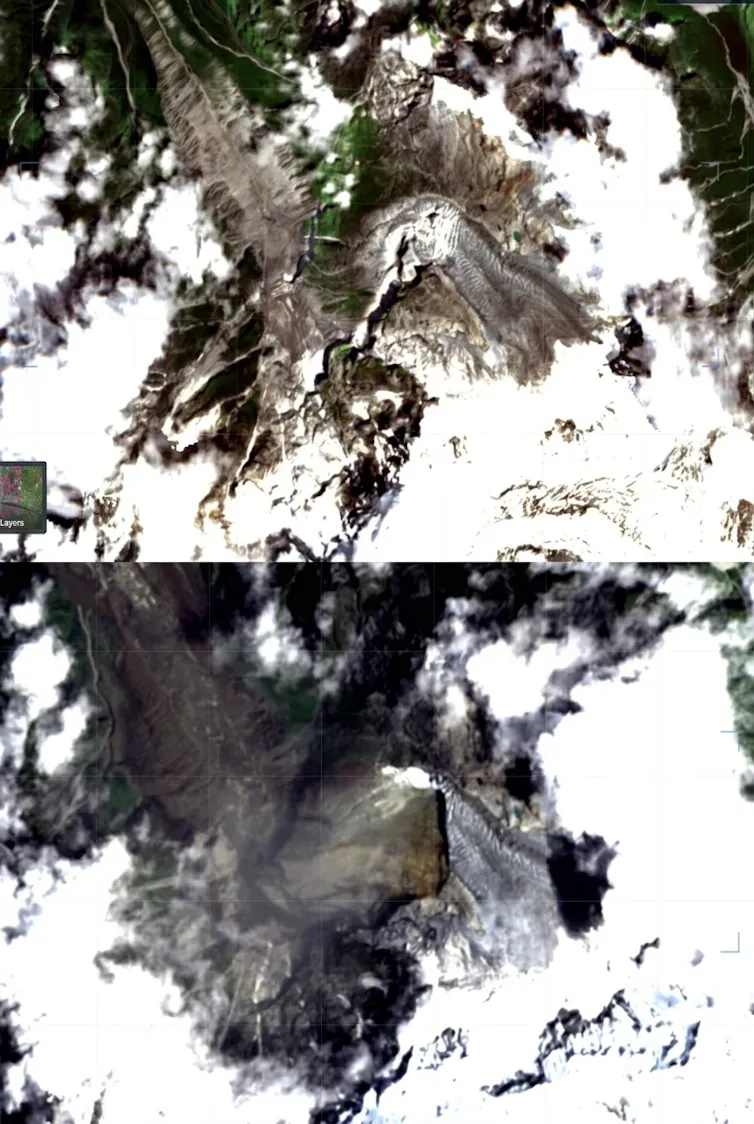
Satellite tv for pc pictures of the glacier prior to (above) and after its cave in on August 26.
ESO Sentinel, CC BY-SA
In the newest Nepal catastrophe, sediment can have been redistributed throughout the catchment. Channels can have modified, and a few slopes could have been destabilised. Embankments that when guided water and sediment had been broken or destroyed totally.
Communities can lift those results ahead too. The similar river hall skilled severe flooding in 2025, when lives have been misplaced, a Nepal–China friendship bridge was once destroyed and shipping and industry have been disrupted. Some communities affected this week have been nonetheless dwelling with the effects of a prior catastrophe.
Crisis making plans must consider a modified panorama
Early caution has to maintain and this catastrophe is an additional get up name to handle elementary demanding situations round disaster-risk control. Early-warning methods are steadily constructed round recognized hazards and recognized thresholds: a selected river stage, rainfall depth or volatile slope. However main occasions can alternate the geography of the danger itself. After a landslide or particles waft, a prior to now minor tributary might include massive amounts of cellular sediment, whilst a river that in the past carried monsoon floods safely could have transform shallower or narrower. Evacuation routes can disappear.
A danger map produced prior to such an match might due to this fact supply an more and more deficient illustration of what occurs afterwards. One of the vital objectives of our challenge is to broaden techniques to trace the ones adjustments and feed them into menace tests and new good early-warning methods.
Cascades considering method asking how one catastrophe adjustments the prerequisites for the following. The floods in Nepal will go away at the back of altered river channels, volatile slopes and broken infrastructure. The following heavy rainfall – or collapsing glacier – will stumble upon that modified panorama.